

Follow the remarkable story of Rubia cordifolia from the Himalayan forests of ancient India, across the Silk Roads, into royal workshops, Ayurvedic texts and the world's oldest natural dye traditions.
Part of the OmVeda Botanical Library — exploring the botanicals, traditions and science behind Ayurvedic skincare.
Long before synthetic dyes transformed the textile industry, vibrant colours came from the natural world. Among the most prized of these botanical colourants was Manjistha (Rubia cordifolia), a climbing herb whose deep crimson roots produced rich shades of red that were treasured across Asia for thousands of years.
While Ayurveda came to value Manjistha as one of its most respected botanicals, its influence extended far beyond traditional wellness. The same roots that inspired Ayurvedic practitioners also coloured robes, ceremonial fabrics and works of art, leaving their mark on cultures stretching from India to China and beyond.
Where Manjistha First Grew
Long before it appeared in Ayurvedic texts or coloured the robes of kings, Manjistha grew wild among the foothills of the Himalayas.
Rubia cordifolia is believed to have originated throughout the temperate and subtropical regions stretching from northern India and Nepal into Bhutan, Pakistan and parts of western China. It thrives on forest margins, rocky slopes and mountain valleys, where its climbing stems weave through surrounding vegetation while its remarkable crimson roots slowly develop beneath the soil.
Its natural distribution closely mirrors the birthplace of Ayurveda itself. For thousands of years, communities living among these Himalayan landscapes would have encountered the plant as part of their everyday environment, gradually learning how its roots produced vibrant colours unlike almost any other botanical.
Long before written records, Manjistha was almost certainly known through oral traditions, where practical knowledge of plants was passed from generation to generation.
The First Ayurvedic References
By the time Ayurveda's great classical texts were compiled, Manjistha had already become one of India's respected medicinal plants.
The Charaka Samhita (approximately 1st century BCE–2nd century CE) includes Manjistha within herbal formulations, while the Sushruta Samhita similarly describes its place within traditional Ayurvedic practice. Later works, including the Ashtanga Hridayam and Bhavaprakasha Nighantu, further expanded upon its Ayurvedic qualities, energetics and traditional applications.
These repeated references across centuries demonstrate that Manjistha was not an obscure herb, but one that remained consistently valued throughout the development of classical Ayurveda.
Its Sanskrit name, मञ्जिष्ठा (Manjistha), appears throughout these texts, reflecting a botanical already deeply embedded within India's medical and cultural traditions.
From Crimson Root to Coveted Dye
One of the most intriguing questions surrounding Manjistha is whether it was first valued as a medicinal herb or as one of humanity's earliest natural dyes.
The answer has been lost to history.
Long before Ayurveda was committed to writing, botanical knowledge was passed from generation to generation through observation and oral tradition. It is therefore impossible to know exactly when Manjistha first entered traditional medicine. What seems more likely, however, is that its extraordinary crimson roots first captured people's attention simply because of their remarkable colour.
When freshly cut or crushed, the roots release a vivid ruby-red pigment unlike almost any other plant. Long before scientific analysis or written records, this striking colour would have made Manjistha—and other closely related madder species—natural candidates for colouring fibres, baskets, ceremonial objects and perhaps even body decoration.
Archaeological evidence suggests that madder-derived red dyes were already being used across parts of the ancient world more than 4,000 years ago, including within the Indus Valley Civilisation. Although it is rarely possible to determine whether these early dyes came specifically from Rubia cordifolia, the closely related Rubia tinctorum, or other regional madder species, these discoveries demonstrate humanity's remarkably early appreciation of the crimson pigments found within madder roots.
Over countless generations, people observed these remarkable plants more closely. Alongside their importance to textile artisans, they gradually became woven into traditional systems of botanical knowledge. By the time the great Ayurvedic texts were compiled, Manjistha was already recognised as one of India's respected medicinal herbs, suggesting that centuries of practical experience had preceded the written record.
Natural red dyes were among the most prized commodities of the ancient world. Unlike yellow, brown or black pigments, rich crimson colours were comparatively rare and often difficult to produce. Madder roots offered an extraordinary range of shades, from delicate rose and terracotta through to deep ruby and burgundy, depending upon the species, mordant, textile fibre and dyeing technique employed.
As India's expertise in natural dyeing flourished, Manjistha became more than a botanical curiosity. Its pigments coloured cotton, silk and wool, helping establish the Indian subcontinent as one of the world's great centres of botanical textile production. Beautifully dyed fabrics soon became valuable commodities, travelling with merchants across deserts, mountains and oceans to cultures that would embrace both their beauty and craftsmanship.
Although few early Indian textiles have survived the region's humid climate, later examples demonstrate the extraordinary sophistication of dyeing traditions that had been developing for many centuries.
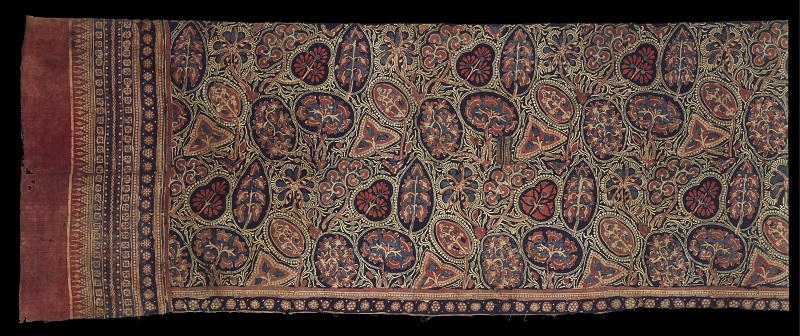
Ceremonial Hanging, Gujarat, India (14th century)
Victoria and Albert Museum, London. This remarkable block-printed cotton textile was dyed using Indian madder (Rubia cordifolia, Manjeet), demonstrating the sophistication of medieval Indian dyeing traditions. Produced in Gujarat for export to Southeast Asia, it reflects India's long history as one of the world's great centres of botanical textile production.
Along the Silk Roads
As trade expanded across Asia, Manjistha travelled alongside silk, spices, precious stones and aromatic woods.
Rather than a single road, the Silk Roads formed an immense network of caravan routes linking India with Central Asia, Persia, China and eventually the Mediterranean world.
Bundles of dried Manjistha root, together with beautifully dyed textiles, moved between merchants carrying knowledge as well as goods. Along these journeys, botanical traditions crossed cultural boundaries, influencing medicine, art and craftsmanship wherever they travelled.
Although silk became the route's namesake, many historians now recognise that medicinal plants, dyes and botanical products formed an equally important part of this thriving trade network.
China Discovers the Crimson Root
As botanical knowledge travelled eastward, species of Rubia became established within Chinese herbal traditions.
Known as Qiàn Cǎo Gēn (茜草根), or madder root, it appears in the Shennong Bencao Jing (Divine Farmer's Classic of Materia Medica), traditionally compiled between the 1st and 2nd centuries CE. As one of China's earliest surviving materia medica, this text records the medicinal use of hundreds of botanicals and reflects the growing sophistication of Chinese herbal medicine.
Within Traditional Chinese Medicine (TCM), Qiàn Cǎo Gēn has traditionally been associated with the Liver and Heart meridians. Classical texts describe it as a herb that invigorates the blood, supports the healthy movement of blood, and helps cool what TCM refers to as "heat in the blood." It has also been traditionally included in formulations intended to support normal circulation and to help maintain healthy skin from the perspective of Traditional Chinese Medicine.
Although the language differs, readers may notice interesting parallels with Ayurveda. Both traditions developed an appreciation for the remarkable crimson roots and both associated the herb with the blood, yet each arrived at these conclusions through entirely different philosophical systems.
In Ayurveda, Manjistha became one of the foremost herbs associated with Rakta Dhatu, the blood tissue, and was traditionally described as a Rakta Shodhaka, a botanical supporting the healthy balance and purification of Rakta Dhatu. Traditional Chinese Medicine, by contrast, understands Qiàn Cǎo Gēn through the concepts of Qi, Blood, Yin and Yang, describing its ability to invigorate and cool the blood according to its own unique diagnostic framework.
These similarities are particularly fascinating because Ayurveda and Traditional Chinese Medicine evolved independently over many centuries. While trade along the Silk Roads undoubtedly encouraged the exchange of plants and botanical knowledge, each medical tradition interpreted Manjistha through its own sophisticated philosophy rather than simply borrowing ideas from the other.
Beyond medicine, Chinese artisans also recognised the remarkable colouring properties of madder roots. Long before synthetic pigments, the crimson dyes extracted from Rubia species coloured silk, cotton and ceremonial textiles, contributing to the rich textile traditions of successive Chinese dynasties.
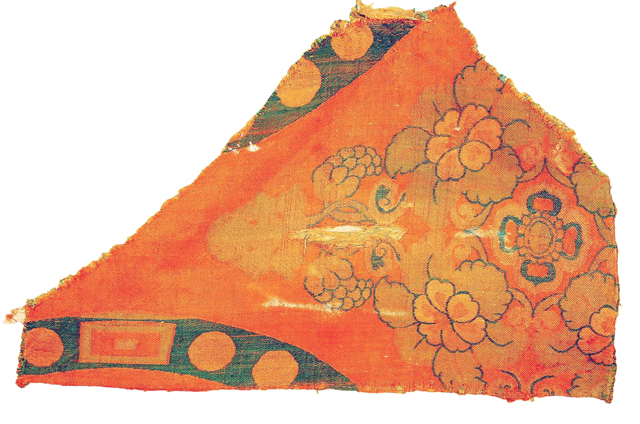
Tang Dynasty Jewelled Brocade (618–907 CE)
China National Silk Museum, Hangzhou, China. This beautifully preserved silk brocade dates to the Tang Dynasty, a period renowned for its flourishing textile production and Silk Road trade. Scientific analysis undertaken as part of the museum's "The Sources of Colours" exhibition identified natural dyes including Indian madder (Rubia cordifolia), dyer's madder (Rubia tinctorum), safflower (Carthamus tinctorius), lac and Armenian cochineal among historic Chinese textiles from this period, demonstrating the sophistication of ancient botanical dyeing traditions.
Persia and Beyond
As caravans continued westward, natural madder dyes became prized throughout Persia and the Islamic world.
Persian carpet weavers employed madder to produce the rich reds that still distinguish many historic rugs today. Although several Rubia species contributed to these traditions, the trade in crimson dye plants helped establish madder as one of history's most influential botanical colourants.
A Crimson Carpet Frozen in Time
One of the world's most extraordinary archaeological discoveries is the Pazyryk Carpet, dating to approximately the 5th–4th century BCE. Unearthed from a frozen burial mound in the Altai Mountains of Siberia, it is the oldest surviving knotted pile carpet known today.
Its remarkably preserved crimson fibres have fascinated historians for decades. Modern scientific analysis has identified evidence consistent with madder-derived dyes, demonstrating that sophisticated natural dyeing techniques were already well established more than 2,400 years ago. Although researchers cannot determine which species of Rubia supplied the colour, the carpet illustrates the extraordinary importance of madder roots across the ancient world.
Preserved beneath Siberian permafrost for over two millennia, the Pazyryk Carpet offers a remarkable glimpse into the artistry, craftsmanship and botanical knowledge of early Eurasian civilisations.
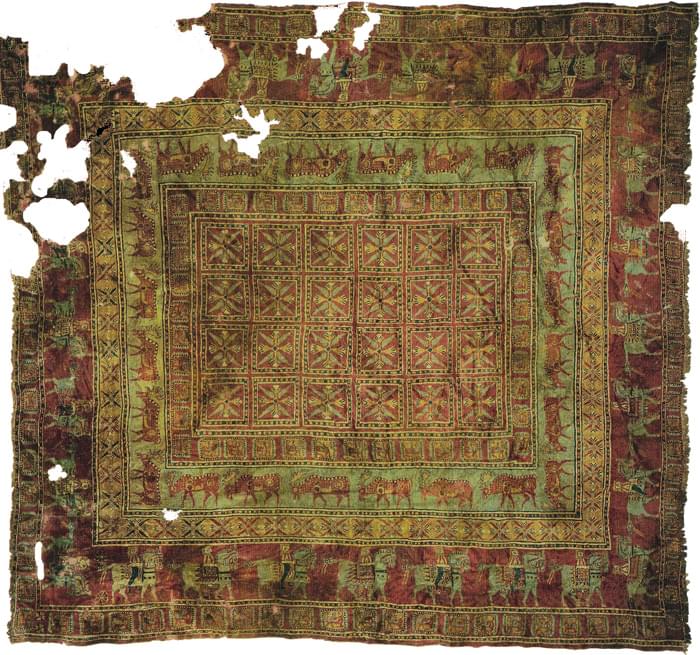
The Pazyryk Carpet (c. 5th–4th century BCE)
State Hermitage Museum, St Petersburg, Russia. Discovered within a frozen Scythian burial mound in the Altai Mountains, the Pazyryk Carpet is the oldest surviving knotted pile carpet in the world. Modern scientific analysis has identified evidence consistent with madder-derived red dyes, demonstrating the remarkable sophistication of natural dyeing techniques more than 2,400 years ago.
The Maritime Silk Road
While caravans carried Manjistha and dyed textiles across the mountains of Central Asia, equally important trade routes crossed the Indian Ocean.
By around the 1st century BCE to the 15th century CE, merchants regularly sailed between India's western and eastern coasts and ports throughout Sri Lanka, Indonesia, Malaysia, Thailand, Cambodia and southern China. Historians often refer to this interconnected network as the Maritime Silk Road or Maritime Spice Route.
These sea routes allowed Indian cotton textiles, spices, aromatic woods, gemstones and botanical dyes to reach distant kingdoms long before European exploration began.
The Boats
The ships themselves were remarkable.
Early Indian merchants sailed in large wooden vessels built primarily from teak, a timber prized for its strength and resistance to rot.
Unlike many European ships of later centuries, Indian Ocean vessels were often constructed using sewn-plank technology, where thick wooden planks were stitched together with coir (coconut fibre) rope before being sealed with natural resins and oils. This flexible construction helped the ships withstand the powerful swells of the Indian Ocean.
By the first millennium CE, larger merchant ships carried:
- cotton textiles
- spices
- sandalwood
- medicinal herbs
- indigo
- natural dyes
- ceramics
- ivory
- precious stones
Many voyages relied upon the predictable monsoon winds, allowing sailors to travel east during one season and return west several months later.
Manjistha Reaches Indonesia
Among India's most valued exports were beautifully dyed cotton textiles.
Historical evidence suggests that by the 13th and 14th centuries, Gujarati textiles coloured with Indian madder (Rubia cordifolia), indigo and other botanical dyes were being exported throughout the Indonesian archipelago.
These fabrics became highly prized luxury goods.
Rather than simply being worn as clothing, many were treasured as:
- ceremonial cloths
- royal gifts
- wedding textiles
- heirlooms
- temple offerings
Some were preserved for generations because of the extraordinary craftsmanship they represented.
Beyond India: A Shared Botanical Heritage
One fascinating aspect of Manjistha's history is that the plant itself did not stop at India's borders. Rubia cordifolia occurs naturally across parts of Southeast Asia, including Sumatra and Java, where it became known by local names and was recognised as both a dye plant and a useful botanical.
What travelled most extensively across the Indian Ocean, however, was not simply the plant itself, but the knowledge surrounding it. Indian merchants carried beautifully dyed cotton textiles, botanical expertise and sophisticated dyeing techniques aboard teak-built trading vessels that followed the seasonal monsoon winds. These exchanges influenced textile traditions throughout the Indonesian archipelago, where local artisans combined imported ideas with their own rich palette of botanical dyes, creating the remarkable weaving and batik traditions that continue to be celebrated today.
Indonesian Textile Traditions
Indian textiles did more than travel.
They inspired.
Throughout Indonesia, local artisans developed their own sophisticated textile traditions while drawing inspiration from imported Indian fabrics.
On islands including Java, Bali and Sumba, Indian cottons influenced decorative motifs, colour palettes and dyeing techniques.
Over time these ideas blended with local traditions to create distinctive Indonesian textiles such as batik, ikat and ceremonial cloths unique to each island.
Although Indonesian dyers also relied upon their own native botanical dyes—including Morinda citrifolia (Indian mulberry or noni root) for reds, indigo, sappanwood and other local plants—the arrival of Indian textiles introduced new artistic possibilities that helped shape regional textile culture.
A Colour Fit for Royal Courts
Across Asia, naturally dyed red fabrics became associated with celebration, prosperity and status.
From royal garments and temple textiles to wedding attire and ceremonial banners, Manjistha's remarkable pigments coloured some of the most treasured fabrics of the ancient world.
Unlike synthetic dyes, every batch carried subtle variations influenced by soil, climate, harvesting methods and the skill of the dyer, making each textile uniquely connected to the landscape from which it came.
The journey of Manjistha reminds us that plants rarely travel alone. Alongside spices, sandalwood and silk, the crimson roots of madder helped carry ideas, artistry and cultural traditions across oceans, weaving connections between communities separated by thousands of kilometres yet united by a shared appreciation of nature's remarkable colours.
The Rediscovery of Natural Dyes
During the nineteenth century, industrial chemistry transformed textile production through the invention of synthetic dyes.
Although botanical dyes gradually disappeared from large-scale manufacturing, they never vanished completely.
Today, artists, conservationists and sustainable textile makers are once again exploring Manjistha, recognising not only its remarkable colour but also the cultural heritage preserved within every crimson root.
Looking Ahead
The journey of Manjistha does not end with trade or textiles.
More than two thousand years after caravans first carried bundles of crimson roots across Asia and merchant ships followed the rhythm of the monsoon winds, Manjistha continues to connect people through science, history, craftsmanship and traditional knowledge. Few botanicals have travelled so widely or left such colourful traces across human civilisation.
In the next article, we'll return to its Ayurvedic origins to explore why generations of practitioners came to regard Manjistha as one of the most important botanicals for beauty, balance and the philosophy of healthy skin.